Establishing a Meditation Posture
Finding a Posture for Meditation
There are many forms of meditation, taught across a wide range of traditions, and there is similarly a range of guidance about how to establish a posture. Of course, mindfulness can be practised while walking, standing and moving through daily life. Traditionally, however, many forms of meditation involve sitting in one way or another.
Here, I will introduce some of the basics of finding a posture that is suitable for you.
When exploring posture, it can be helpful to experiment. There is no single position that works for everyone, and our needs may change from day to day. Fundamentally, the aim is to find a position in which you feel relaxed enough to remain for a period of time, while also alert enough to stay engaged with the practice.
Rather than reclining as you might in an armchair, try sitting upright with a gentle sense of positive intention. This does not mean becoming stiff or forcing the body into an uncomfortable shape. It is more about finding a balance between comfort, relaxation and wakefulness. A posture that feels settled and alert can provide a good foundation for meditation.
There are good reasons for this. Mindfulness teachings remind us that the mind can affect the body, and that the body can affect the mind. If we are slouching, for example, we may notice that we begin to feel sleepy quite quickly. Conversely, if we are overly rigid, the mind may also begin to feel tight, rigid or uptight.
A relaxed but alert posture can therefore support a steady, open and receptive mind: not too wound up, and not too relaxed. It is a little like the string of a guitar - neither too loose nor too tightly drawn.
Choosing how to sit
You may choose to sit on a chair, a meditation stool, cushions on the floor, or cross-legged in a traditional position such as half-lotus or lotus. The most important thing is not to achieve a particular shape, but to find a position that your body can sustain with reasonable comfort.
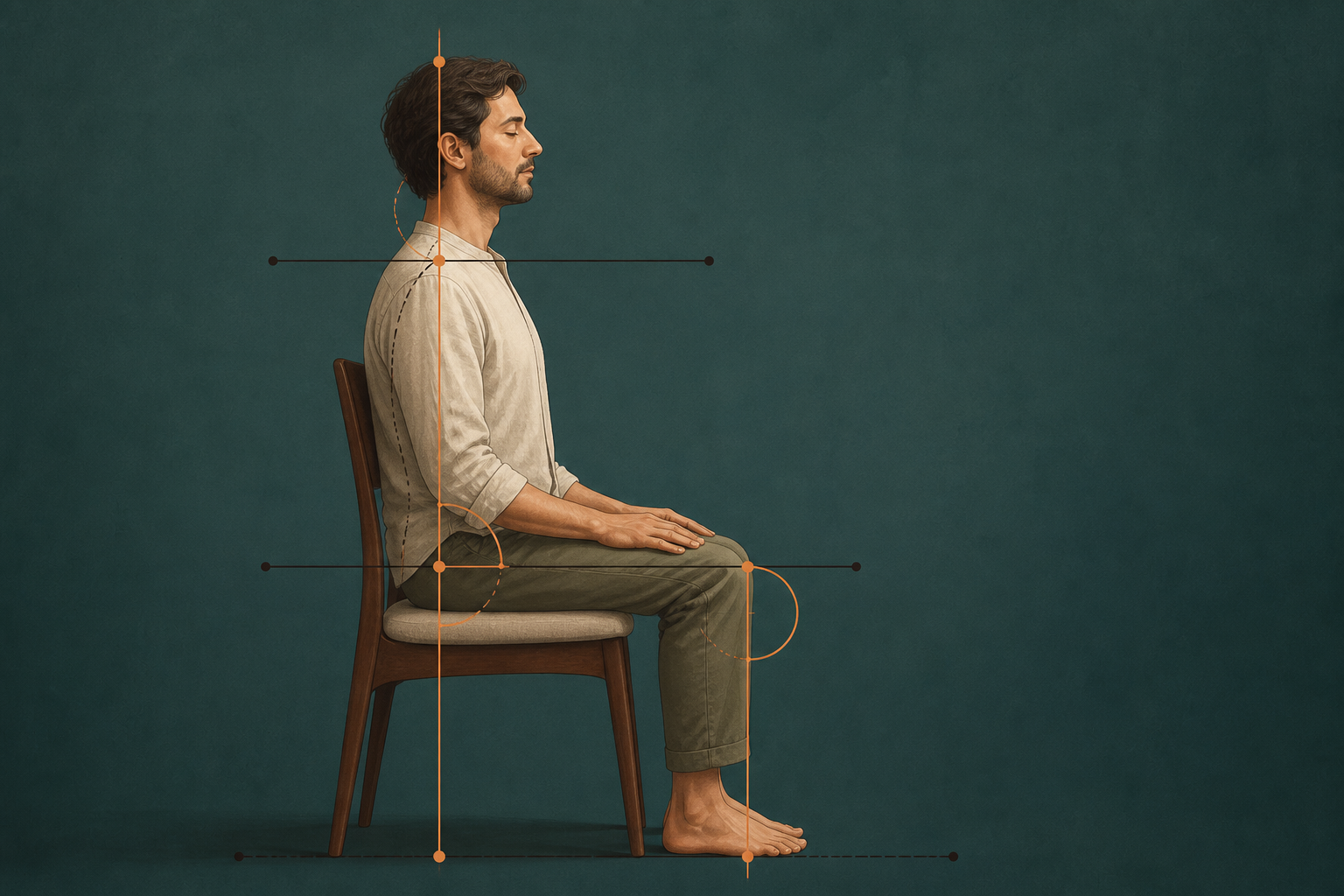
For many people, a chair is an excellent place to begin. Sit your hips towards the front or back of the seat, in a way so that you are not reclining against the back. Allow both feet to rest on the floor, ideally with the knees roughly in line with, or slightly lower than, the hips. If your feet do not comfortably reach the floor, place a footrest underneath them.
Let the hands rest in the lap or on the thighs. The shoulders can be allowed to drop and soften, rather than being pulled back. Imagine that the crown of the head is being gently lifted upwards, allowing the spine to lengthen naturally. At the same time, try not to over-correct or make the back too straight. The aim is a sense of ease and length, rather than a rigid line.
A meditation stool or cushions may naturally encourage the pelvis to tilt slightly forwards, allowing the back to lengthen more easily. If you sit cross-legged, placing a cushion beneath the hips can often make a significant difference. Raising the hips slightly above the knees may reduce strain and help the body settle.
If you are sitting on the floor, it is useful to make sure that the knees feel supported. You may wish to place cushions or folded blankets beneath them. There is no prize for sitting in lotus or half-lotus. These positions are not suitable or comfortable for everyone, and a chair may provide a much better foundation for practice.
Small adjustments that can make a difference
Once you have chosen a position, take a few moments to make small adjustments before beginning. It can be tempting to settle quickly and start the practice, but a minute spent attending to posture may help you sit more comfortably for longer.
You might check the following:
Are both sitting bones supported by the chair, stool or cushion?
Are you leaning forwards or backwards without realising it? See whether you can bring your weight into a more balanced position.
Is the jaw tense? Allow the jaw, tongue and muscles around the eyes to soften.
Are the shoulders lifted towards the ears? Let them drop gently.
Is the head pushed forwards or tipped back? Allow it to rest lightly above the neck, with the chin very slightly tucked.
Are you holding the stomach tightly? See whether you can soften the abdomen enough to allow the breath to move freely.
Is your body shape open or closed - maybe try bringing the shoulders slightly back to open the chest, or upturn the palms in receptive fashion.
These are not rules to be performed perfectly. They are invitations to become curious about how the body is organising itself. Sometimes, simply noticing unnecessary tension allows it to ease.
Working with discomfort
It is natural to experience some sensations while sitting: pressure where the body meets the chair or cushion, warmth, tingling, stiffness or the urge to move. Some discomfort may be part of learning how the body responds when we are still. It can be helpful to notice these sensations with interest before immediately reacting to them.
At the same time, meditation is not an endurance test. If you are experiencing pain, numbness, sharp discomfort or a level of strain that feels unhelpful, it is sensible to adjust your posture. You might change the position of your legs, add another cushion, place support behind the lower back, or stand and stretch before returning to the practice.
When you do move, you can make the movement part of the meditation. Notice the intention to change position, the movement of the body, the contact of the feet or hands, and the sensations that follow. In this way, the adjustment need not feel like an interruption to the practice.
If you have an injury, ongoing pain, dizziness or another health concern, choose a posture that is safe and appropriate for you. It may be helpful to seek professional advice where needed. Mindfulness can be practised in many positions, including lying down or standing, and there is no need to force the body into a shape that does not suit it.
Open or closed eyes?
You may have noticed that images of people meditating often show them with their eyes closed. Many people do keep their eyes closed for the whole practice, particularly when first learning to meditate. For some, this helps reduce visual distraction and makes it easier to settle.
However, there are different teachings about whether to keep the eyes open, half-open or closed. Some practitioners prefer to rest their gaze softly on the floor a short distance in front of them, while others keep their eyes gently open throughout the practice. This can help them remain alert, and may feel more comfortable for people who become drowsy or unsettled when they close their eyes.
Feel free to experiment in your own practice. You might try both approaches and notice which supports a sense of ease, steadiness and awareness.
Let posture support the practice
At the beginning of a meditation, it can be helpful to take a few deeper, softer breaths and then make one final check of the body. Feel the contact between your body and the chair, stool or cushion. Notice the feet on the floor, the hands resting in the lap, and the natural length of the spine.
During the practice, check in with your posture from time-to-time. You may occasionally become aware that you have gradually slumped, tightened the shoulders or shifted into an uncomfortable position. There is no need to judge this. Simply notice what has happened and, if it feels helpful, make a small and mindful adjustment.
Posture is not something we establish once and then forget. It can be part of the practice itself: an ongoing invitation to notice the body, to respond with kindness, and to find again that balance between effort and ease.
For experienced meditators, this awareness need not end when the meditation ends. As you stand up, walk around or return to the next part of your day, notice how you are holding yourself. Bringing the same gentle attention to posture in daily life can help us carry mindfulness beyond the chair, stool or cushions and into everything we do.