Phsycian Care
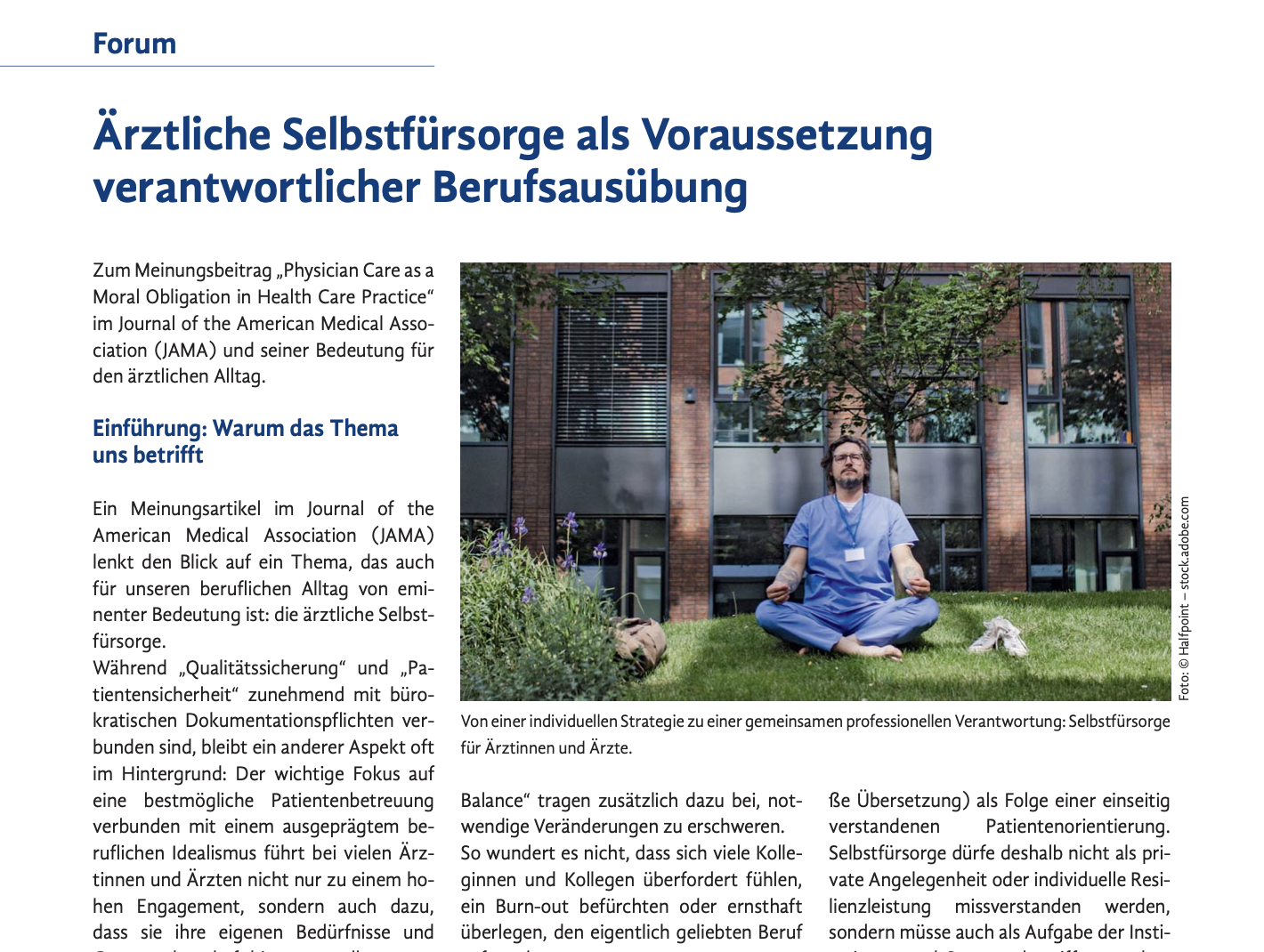
This is an English translation of the commentary on my JAMA article, ‘Physican Care as a Moral Obligation in Health Care’ in the German Hessian Medical Journal (Hessisches Ärzteblatt), published on 20th March 2026.
Medical Self-Care as a Prerequisite for Responsible Professional Practice.
On the opinion piece “Physician Care as a Moral Obligation in Health Care Practice” in the Journal of the American Medical Association (JAMA) and its significance for everyday medical life.
Introduction: Why the topic concerns us
An opinion article in the Journal of the American Medical Association (JAMA) draws attention to a topic that is also of eminent importance for our professional daily routine: medical self-care.
While "quality assurance" and "patient safety" are increasingly associated with bureaucratic documentation obligations, another aspect often remains in the background: the vital focus on the best possible patient care combined with a pronounced professional idealism leads many doctors not only to high levels of commitment, but also to permanently putting their own needs and boundaries on the back burner.
Over many years, as part of psycho-oncological advanced training, I have gathered experience in team supervision with mixed professional groups. In doing so, I was always impressed by how well many psychologists have learned to pay attention to their own limits, while even very experienced doctors had hardly practiced self-care. Often, a reorientation only took place when continuing to work in the previous form was no longer possible.
Precisely for this reason, from my point of view, it is also enormously important in terms of professional policy to support young colleagues in particular in understanding self-care as a prerequisite for providing good and safe care to patients. In many clinical structures, however, the opposite still happens: overwork is tacitly expected, and the awareness of one’s own limits is hardly encouraged. Disparaging remarks about "work-life balance" additionally contribute to making necessary changes more difficult. It is therefore not surprising that many colleagues feel overwhelmed, fear burnout, or seriously consider giving up a profession they actually love.
Self-care as an ethical obligation and a prerequisite for quality-assured medicine should therefore be – or become – a matter of course.
Central thoughts of the opinion article published in JAMA
Under the title “Physician Care as a Moral Obligation in Health Care Practice,” Michael Philip Atkinson develops an explicitly ethical perspective on this topic. The starting point of his reflections is the traditional self-understanding of the healing professions, which from the beginning of training emphasizes consistent alignment with the patient's well-being. This ethos is indispensable, but – according to Atkinson – it can unintentionally lead to the well-being of the practitioners being lost from sight.
He warns of a “systematic marginalization of the self-well-being of health professionals” (paraphrased translation) as a result of a one-sided understanding of patient orientation. Self-care should therefore not be misunderstood as a private matter or an individual feat of resilience, but must also be understood as a task for the institutions and systems in which medicine takes place.
The discussion about medical well-being has so far often been conducted primarily functionally – for example, to avoid burnout or to ensure performance. Atkinson argues beyond this that self-care is “not just supportive of patient care, but morally constitutive of it” (own translation). If working conditions predictably lead to exhaustion, susceptibility to errors, and internal distancing, the system itself comes into conflict with the medical-ethical principle of non-maleficence (doing no harm).
This shifts the perspective: not only individual behavior, but also structural framework conditions become an object of ethical responsibility. A system whose conditions predictably lead to overload and error-proneness thus itself becomes an ethically relevant factor in care.
At the same time, Atkinson emphasizes the importance of professional role models. Attitudes toward self-care are conveyed less through guidelines than through lived practice. If experienced doctors demonstratively model self-sacrifice, this can act as a tacit norm. If, on the other hand, a responsible approach to one’s own resources is visibly practiced, self-care can be understood as an expression of professional attitude and not as a sign of lack of commitment.
A sustainable understanding of medical self-care therefore goes beyond individual measures. Also required are organizational framework conditions – appropriate workload, reliable personnel structures, and times for regeneration – that enable a permanently responsible professional practice. Individual offers such as mindfulness programs can be helpful, but remain limited if they do not accompany structural problems. Self-care must therefore not be delegated as a private task but requires organizational conditions that make responsible medical action possible in the first place.
These reflections make it clear that medical self-care cannot be understood as an individual supplementary topic, but is closely linked to the structural conditions of medical activity.
Atkinson therefore calls for a cultural and institutional anchoring of self-care in training, leadership, and organizational ethics. Only if working conditions, personnel structures, and leadership behavior support this attitude can self-care evolve from an individual strategy into a shared professional responsibility. Otherwise, there is a risk that initiatives to promote medical self-care remain symbolic, while overload and a creeping erosion of professional standards continue.
Medical self-care thus proves to be an essential prerequisite for responsible professional practice and therefore also a topic that medical self-administration must keep in view.
Dr. med. Peter Zürner
Member of the Executive Board of the State Medical Chamber of Hesse (LÄKH), Managing Editor of the Hessisches Ärzteblatt